Doctoral Dissertation
Single silicon vacancies in SiC
Introduction
Engineering defects with high accuracy (Ohno et al., 2014) is of high interest, as each application needs differently located defect centers. This was conducted for the NV-center in diamond for various applications. The NV-center is not the only defect in diamond whose single electron spin and a coupled nuclear spin can be initialized and read out at room (see Section, and ref. (Lee et al., 2013)). To extend on this, it is known that diamond can host more than 100 other color centers (Zaitsev et al., 2006). To highlight a few encouraging systems: the silicon-vacancy (Feng & Schwartz, 1993; Rogers et al., 2014) in diamond, chromium (Aharonovich et al., 2010) and germanium (Iwasaki et al., 2015) were investigated and show promising properties for various quantum applications. The success of these quantum systems for room-temperature qip is based on diamond’s weak spin orbit coupling, a dilute nuclear spin bath, and large band gap.
In particular, the wide band gap allows these systems to form thermally stable energy levels and a broadband optical access. For materials with a smaller band gap, such as silicon, their quantum systems (formed for example with a phosphorous dopant) need to be cooled to low temperature (Morello et al., 2010). Their energetic levels lie slightly below the conduction band. Hence, those systems have the issue with the fact that their quantum states are easily destroyed via thermal excitation into the conduction band. However, silicon also benefits from the narrow band gap, as it allows efficient n- and p-type doping with high doping concentrations. As this process is very well developed, their integration into modern electronic device is not difficult. This means finding a material combining properties of diamond and silicon. As a first starting point one would aim to find a material possessing a larger band gap than silicon but smaller than diamond.
Silicon carbide nicely suits in that respect, as it provides a band-gap of about 3 eV, which allows the material to have various energy levels within the band gap. In addition SiC benefits from mature doping and fabrication processes. Moreover, silicon carbide is composed of silicon and carbon, and crucially both atoms are available with nuclear spin free isotopes (namely C, Si). Nuclear spin free hosts are desirable as non-zero nuclear spins are one reason for the shortening of spin coherence times. Therefore, several defect-type systems in SiC have been proposed as promising candidates for more detailed research. In 2011, ensemble di-vacancies spins have been coherently controlled by microwave and optical means (Koehl et al., 2011), and in the same year the silicon vacancy have been suggested as a promising quantum system (Baranov et al., 2011). However, the engineering of single spins remained elusive or rather speculative (Fuchs et al., 2015), as a clear identification via odmr or a spectrum obtained at low temperature of a single center was not provided. In this chapter the engineering of single quantum emitters in SiC is presented and their identification as the silicon vacancy is unambiguously shown. The coherent single spin manipulation is conducted in Chapter 3.
Engineering of Single Silicon Vacancies
Silicon vacancies are mainly created with a bombardment of the host crystal with particles. Such a bombardment can be achieved using neutrons () (Fuchs et al., 2015), protons (Kraus et al., 2017) and electrons (Widmann et al., 2015). Neutron bombardment can be performed with energies of 0.18–2.5 MeV in a fission reactor (Fuchs et al., 2015). However, such a process can lead to transmutation doping (Heissenstein et al., 1998; Ionov et al., 2006). This doping process is based on a nuclear reaction where silicon is converted to phosphorous emission according to , where neutron is captured by Si with natural abundance (Si) = 3.2%. Because Si is unstable it will beta decay to P which leads to an additional n-type doping. Proton irradiated vacancy spins do not suffer from a such unwanted doping. However, the achieved ensemble spin-coherence times were found to be rather short, with a T of 42±20 µs at room temperature (Kraus et al., 2017). The most established method is electron irradiation, which creates silicon vacancies homogeneously (penetration depth about 2–3 mm for 2 MeV electrons) through the sample.
Based on own experiments, 2 MeV electron irradiation with doses higher than 1×10¹⁴ cm⁻² create ensembles of silicon vacancies. To control the defect concentration in a high purity semi-insulating 500 µm thick 4H-SiC sample, the irradiation dose is varied over two orders of magnitude from 1×10¹² cm⁻² to 5×10¹⁶ cm⁻². No post-irradiation annealing was performed (see for further information).
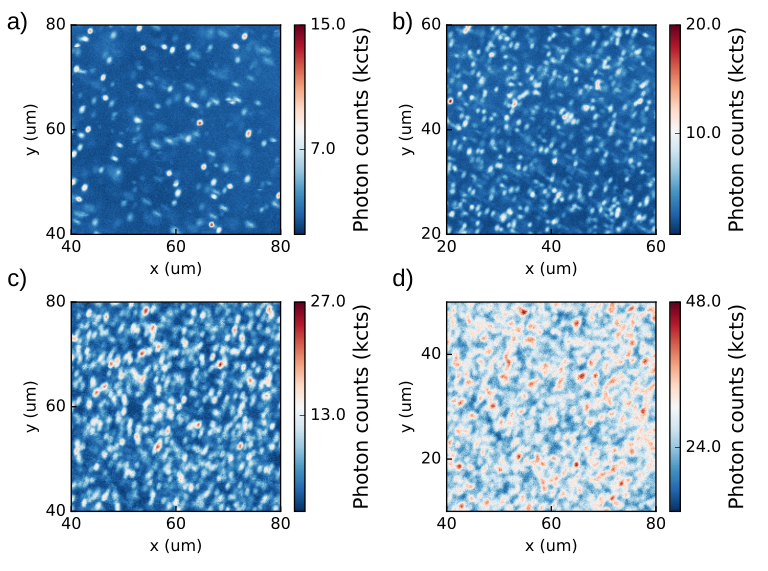
Figure 2.1: Confocal scans with different irradiation doses. Confocal scans with different irradiation doses. a) with 1×10¹² cm⁻² b) 4×10¹² cm⁻², c) 1×10¹³ cm⁻², d) 6×10¹³ cm⁻²
As shown in Figure 2.1 the number of defects increases with higher irradiation dose Figure 2.1a) to d). By means of electron irradiation dose the highest dose to achieve separated single vsi is 6×10¹³ cm⁻².
Defect density determination
The defect concentration estimation can be done by direct count of the single defects, as performed in (Fuchs et al., 2015). However that approach does not distinguish between double or triple defects with spacings below the resolution of the confocal microscope. Another way for defect density determination shall be presented in the following.
First, the confocal volume needs to be determined in conjunction with the mean intensity of a single emitter .
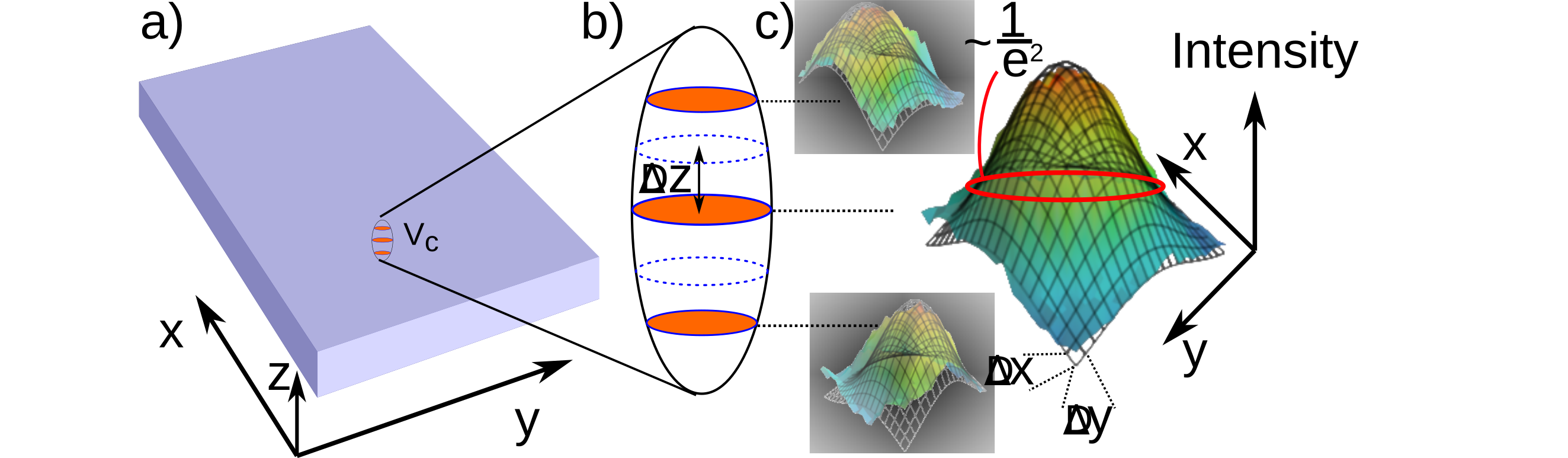
Figure 2.2: Confocal volume determination. a) showing the sample and the confocal volume. b) A zoomed version of in a) illustrating a few sections used to determine confocal volume. c) Confocal sections are shown, where the intensity is encoded in the z direction. The color-coded areas are measurement data and the black grids show 2D-Gaussian fits. The red ring shows the drop in intensity to which will be accounted for intensity summation.
That can be achieved by confocal raster scan of a single defect scanned with resolution of , and as shown in Figure 2.2. At each the emitter is scanned in -direction an fitted to a 2D-Gaussian where intensity is cropped to after background correction. Then the total intensity at the given -position is summed and repeated at each , according to:
The corresponding confocal volume can be determined with , with typical experimentally obtained values of about 10 µL.
To determine the volume density from a large confocal scan containing many emitters can be calculated as:
where specifies the confocal volume, the number of pixels of a performed wide xy-scan as shown in Figure 2.1. specifies the total count rate of the wide scan normalized by the mean intensity of a single defect per pixel in a confocal volume :
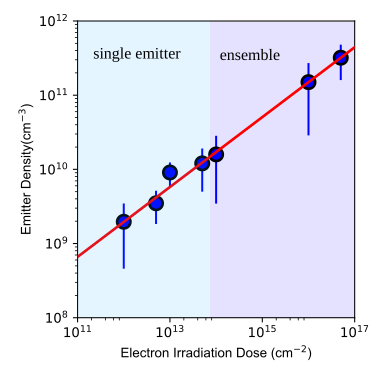
Figure 2.3: Concentration of single silicon vacancies. plotted as a function of electron irradiation dose . The concentration is found by the mean intensity of a large confocal scan divided by the mean intensity of a single defect in the confocal volume . The orange-colored line is a fit to a power law , with and .
With an increased irradiation dose the defects spatially overlap and cannot be resolved anymore. That results simply in a homogeneous confocal raster scan (not shown). The number of defects is following an empirical power law, which is given by (Fuchs, 2015):
where specifies the irradiation dose, and are set as free fit parameters, as plotted in Figure 2.3. That result was used to determine the defect density at higher irradiation doses. The number of defects increases with higher irradiation dose, leading to increased PL intensity. Annealing the sample at 750°C, typically under Ar atmosphere, reduces the number of vsi defects drastically (Sörman et al., 2000), as they become mobile and form together with carbon vacancies another promising spin-qubit, namely the divacancy (Christle et al., 2015).
Detection Efficiency Improvement
To investigate single emitters it is required to collect as much photons, with a time averaged intensity , as possible because the measurement time scales with . The discussion is in great detail explained in ref. (Siyushev, 2014) and is adopted for SiC here. Photon losses occur on each optical component built in the confocal apparatus. A typical silicon apd has quantum efficiencies between 0.5 and 0.3 depending on the wavelength. By using a superconducting nanowire detector, efficiencies of 0.97 were reported. These kind of detectors, tailored to a specific wavelength-range, can be obtained by several companies nowadays. Other optical components such as lenses typically have high transmissions up to 0.98 thanks to anti-reflexion coatings. The efficiency of the pinhole, responsible for the spatial resolution, depends on many other parameters such as the magnification of the objective, the focal length of the lens in front of the pinhole, the size of the hole, etc.
Usually it is possible to achieve up to 0.9 transmission through the pinhole. Most of the optical components have good transmission, including complex objectives with transmissions of 0.9. The main losses occur at the initial collection of the light, which is an interplay between the objectives na and the emitting defect in the crystal. An oil-immersion objective with na of 1.35 and with a typical immersion oil with refractive index can collect light within a cone of about 125° which equates to about 1.09. Because of that, only a fraction of about 25% can be collected assuming a spherically emitting light source where the radiation is distributed over 4 as shown in Figure 2.4a. However, this does not render the reality fully, as additional refraction and reflexion occurs due to different refractive indexes and . Because of the high refractive index of SiC in the visible spectral range, total internal reflexions occur at the crystal-oil or crystal-air interface and the photons are trapped inside the crystal. Total internal reflection occurs according to Snell’s law for angles larger than for which equates to 0.39 . The fraction of light escaping the crystal can be calculated as (Siyushev, 2014):
(2.1)
According to Equation 2.1 a fraction of 9.7% of all emitted photons leave the crystal in the hemisphere. Due to the small acceptance angle of the objective, this number is further reduced to 7.5%.
A smart way to improve the collection efficiency of the system is to place a hemi-spherically shaped lens on top of the crystal, so called sils (Mansfield & Kino, 1990). The use of sils especially enables an increase of the collection efficiency of the optical collecting system and also increased the resolution. In 2002 that was demonstrated for overgrown quantum dots (Zwiller & Björk, 2002). It was then adapted for quantum emitters in other materials, such as NV-centers in diamond (Jamali et al., 2014; Siyushev et al., 2010).
To increase the collection efficiency with a sil, various geometrical shapes can be used, namely the Weierstrass sil (Barnes et al., 2002) and the hemisphere geometry. The Weierstrass sil compresses the light into a small na (Zwiller & Björk, 2002) but suffer from strong chromatic aberrations (Jamali et al., 2014). The hemisphere geometry does not endure aberrations and is therefore beneficial for quantum systems emitting in a broad spectral range, typically several tens of nanometers.
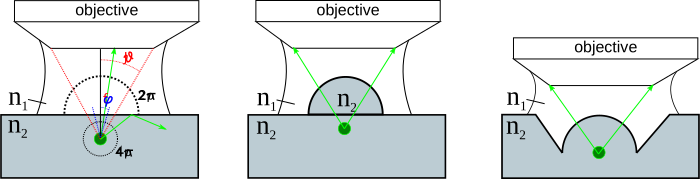
Figure 2.4: Schematic illustration of an emitter in a bulk (left) and solid immersion lens (right). Green arrows indicate possible light paths, red arrows indicate total internal reflexion.
The hemisphere could be created using another material eg with gallium phosphide (Wu et al., 1999), enabling high numerical apertures of 2.0, which is placed on top of the emitter. Such an approach is good for quantum emitters not embedded in a solid, such as molecules or 2D-materials. In solids it is possible to simply mill the crystal into the lens shape directly using focused ion beam milling, which was demonstrated for NV-centers (Jamali et al., 2014; Siyushev et al., 2010) in diamond.
The achievable collection efficiency can be determined by modeling the defect as a dipole, oscillating parallel to the surface in a harmonic fashion with a dipole moment . The magnetic and electric fields and , respectively are defined by (Siyushev et al., 2010):
where defines the distance between the dipole to the observation point, and the wave-vector. The emitted light will have p and s polarized components distributed over with respective normalized intensities and . The direction of the emission is set by the polar angle and azimuthal angle . The intensities can then be written as:
The collection efficiency can then be calculated by summing the components and integration over to the maximized collection angle for a hemispherical sil and from 2 to :
where and are the respective Fresnel equations for s and p polarized light. For 2.55 and 1.56, the collection efficiency calculates to 35%.
Fabrication of a Solid Immersion Lens
As explained in the last section, to increase the collection efficiency a sil needs to be fabricated into the polished surface of the sample using a fib mill (FEI Helios Nanolab 600, 40 keV). The milling process is illustrated in Figure 2.5.
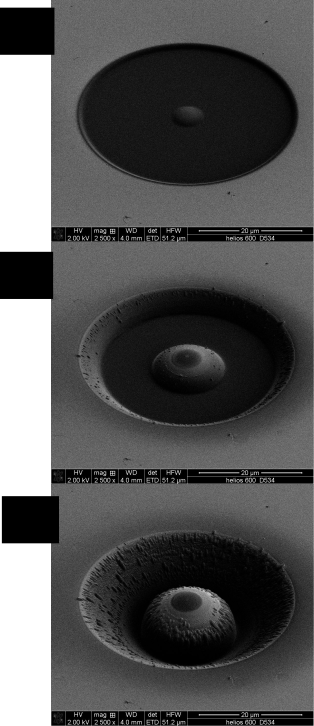
Figure 2.5: SEM images of the SIL fabrication process. a)-c) Milling process of a solid immersion lens in 4H-SiC.
Prior to fib process the sample needs to be prepared in the following way. The first step is to remove organic residuals on top of the sample, using a 1:1:1 mixture of , , with typical bath dwell times of about 20 min.
Subsequently a 50 nm thick gold layer was sputtered onto the sample surface in order to prevent surface charging while the sample is in the milling process. The milling process is illustrated in Figure 2.5a-c.
Residual damages
After milling and gold removal by aqua regia, according to:
the sample still exhibits a bright surface emission prohibiting any further measurements. The surface emission is here caused by lattice damage induced by the milling with heavy ions (Ga). Typical damages are monovacancies and divacancies, as well as interstitial atoms (silicon, carbon).
Additionally, the Ga ions are also implanted into the crystal with a typical penetration depth of 20–30 nm (Robertson et al., 2017). The implantation happens if the ions are not backscattered out of the target surface. Instead the ions come to rest at around 25 nm below the specimen surface (Robertson et al., 2017). Moreover, the electrons used for the scanning electron microscope penetrate into the crystal as well.
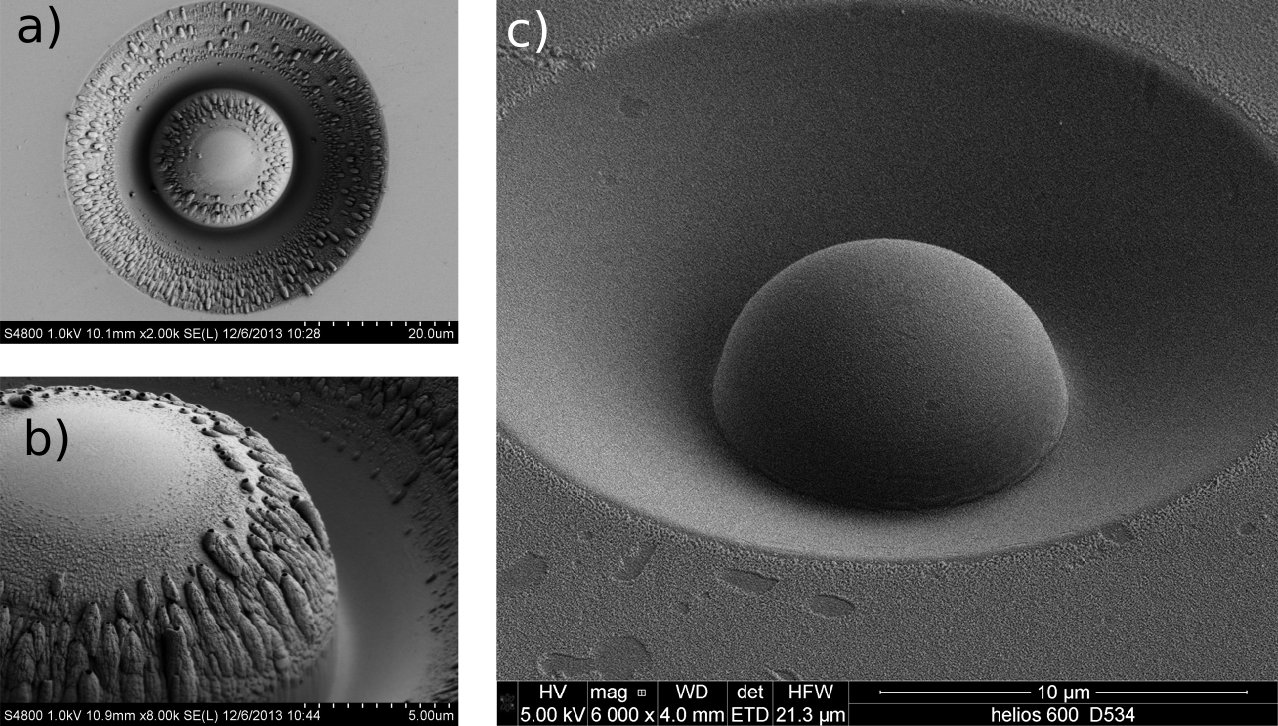
Figure 2.6: SEM images of the residuals. a) Top view of the final SIL with surface residuals. b) Zoomed view showing the residuals. c). SIL after wet-etching process.
The bright surface emission, originated by electron scanning, was tested for spin signal. As shown later in Section 2.5, a positive odmr-signal at 70 MHz originates from . As a spin signal was found on the electron scanned areas, 10 keV electrons create ensembles of silicon vacancies close to the surface in conclusion. After sil fabrication, an amorphous layer due to the heavy ion penetration and a crystalline layer containing ensembles are formed. A common way to remove such damage are annealing techniques where the crystal damages are annealed at high temperature (see ). Temperatures of 750°C (Itoh et al., 1990; Kawasuso et al., 1996; Maier, 1993) is necessary to heal the silicon monovacancy. In addition more complex multi-vacancy clusters or vacancy chains can sustain at temperatures up to 1500°C, for which specially designed high-temperature furnace is necessary.
| Treatment | SIL top (kcts) | bright beside SIL (kcts) | beside SIL (kcts) |
|---|---|---|---|
| NONE | 1500 | 1750 | 1750 |
| ACID | 1500 | 1750 | 1500 |
| HF | 1500 | 1750 | 1750 |
| ACID | 4000 | 4000 | 2000 |
| ACID | 4000 | 4000 | 2000 |
| HF | 2700 | 2400 | 1000 |
| ICP | 70 | 150 | 70 |
Different etching methods and their influences on the measured background signal. All values were obtained with 660 nm laser excitation with 13.5 mW and spectrally filtered with a 850 nm lp. As it can be seen in the last two steps, the combination of hf and icp etching removed the layers and the previous steps are not necessary.
In 1998 it was found that the bombardment with heavy ions indeed invokes amorphous SiC (Menzel et al., 1998). The amorphous residuals are shown in Figure 2.6a-c. The amorphous layer cannot be removed by conventional plasma etching, because the amorphous layer acts as an etch-stop layer. Hence the amorphous SiC layer needs to be removed first. To achieve such removal, a 4-hours lasting wet etching in a 1:1 mixture of 49% +69% is necessary at room temperature. Wet etching processes of semiconductors are based on oxidation of the surface of the semiconductor with subsequent dessolution of the oxides (Zhuang & Edgar, 2005). Oxidation needs holes that can be provided by chemical, electrochemical or photochemical means. Semiconductors get oxidized due to the redox potential of the oxidizing agent in the electrolyte. The agent depletes electrons in the valence band of the semiconductor, and thus holes are supplied (Zhuang & Edgar, 2005). However, such a process is only thermodynamically possible when the redox potential is higher compared to the semiconductor potential (Zhuang & Edgar, 2005). Although crystalline SiC is inert to aqueous etchants (Edmond et al., 1986), the amorphous layer allows the redox agents to break the bonds.
After the removal, the dry etching process can remove further irradiation damage in the crystalline form of SiC. Although dry etching also creates point-defects at the surface (Kawahara, 2013), the sil is clean enough for confocal measurements, as shown in Figure 2.6c.
During this work, several sils were fabricated with diameters of 5 and 10 µm. However, due to residuals which are still present at the inner boundary of the hemisphere even after etching, the confocal image was strongly disturbed and a single defect study was not possible on those samples. To circumvent this drawback, the sil was created with 20 µm diameter.
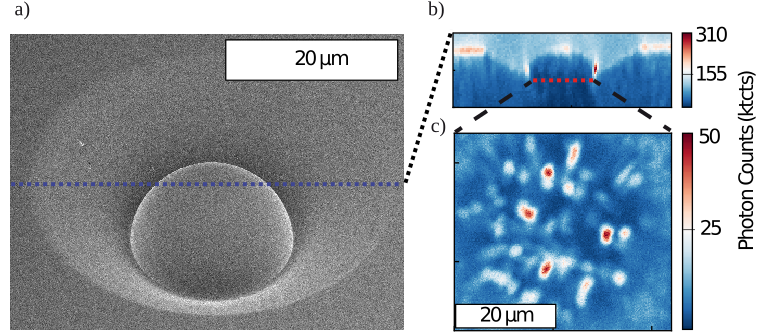
Figure 2.7: A solid immersion lens in 4H-SiC. a) Raster electron microscope image of a sil with a diameter of 20 µm. b) Confocal raster scan along the blue dashed line from a). The bright emission at the surface are residual crystal damages after wet- and dry-etching containing mainly vsi (confirmed by odmr) and other vacancies and Ga-impurities. c) A zoom-in of b) in the x-y-plane, showing single vsi. The excitation wavelength was 730 nm with a power of 12 mW.
Experimental Result
The successful etching process is presented in Figure 2.7. Clearly seen are the fluorescent emitter as red roundish-shaped spots. To determine the pl intensity and the increased collection efficiency of the single photon emitting defect, the pl was measured as a function of the laser power, as shown in Figure 2.8. The intensity data was fit to the equation:
(2.2)
where specifies the saturated pl intensity, and corresponds to the laser power to achieve half of the emission when the emitter is saturated.
Due to the sil, the detected fluorescence was increased by a factor of about 2.7, which is less than the expected value of 10. That is attributed to the non-perfect semispherical shape and further enhancement can be expected by optimizing the fib process. The increased collection efficiency was confirmed by a direct comparison of the fluorescence intensity between a single emitter in the bulk besides the sil and inside the sil, as plotted as a function of the excitation laser power in Figure 2.8.
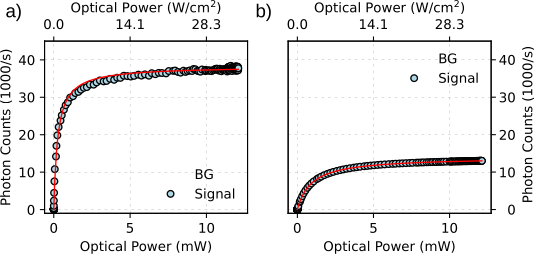
Figure 2.8: PL emission as function of the laser power. Comparison of the integrated photo luminescence between a single vsi in a) in the sil and b) in bulk, both in the same 4H-SiC sample irradiated with 2 MeV electron with a fluence 6×10¹³ cm⁻². The data is fitted to , where is the emission when the emitter is saturated and corresponds to the laser power to achieve saturated value at half its maximum value. For a) = 38×10³ cts and = 0.26 mW, and for b) = 14×10³ cts and = 0.92 mW was found. The achieved collection efficiency enhancement is found to be a factor of 2.7.
Single Emitter Detection
The crucial proof that a defect is a single emitter is given by the measurement of the second-order correlation as introduced in using a hbt experimental configuration (Hanbury Brown et al., 1954). The obtained function is plotted in Figure 2.9. A value at zero time delay well below 0.5 proves the non classical light originating from a single quantum emitter.
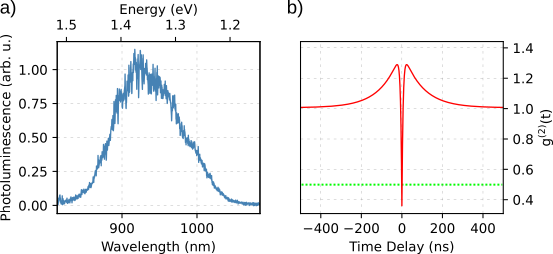
Figure 2.9: PL spectrum and second order correlation of a single . in the sil, measured at room temperature with 730 nm and an excitation power of 0.1 mW. a) Typical PL spectrum of a vsi, the zpl is not visible at room temperature. b) Second order correlation, measurement data (blue) is fitted with a double exponential (red) and explained in the main text. Crucially, the value at zero time delay () is well below 0.5 (marked by the green dashed line), indicating a single emitter. The bunching is a strong hint for a metastable state, which is necessary for a electron spin polarization in the ground state of the system.
The deviation from an ideal single quantum emitter, where is on the one hand caused by the finite time resolution of the apds. However, it is not caused by the dead time of the apds, but rather caused by the timing jitter. More impact has the relatively long integration times up to several hours and the low photoluminescence, which adds dark counts from the apds to the non-classical light. Such contribution cannot be removed by the background correction.
As introduced in the function needs to be corrected for BG emission:
where is the non-corrected -function. According to ref. (Beveratos et al., 2002), can be corrected for the background contribution, by knowing the signal intensity and the background intensity :
where . The observed bunching > 1 is a strong indication of the presence of a metastable state, as shown in Figure 2.9b).
Photoluminescence Stability
In order to test if the vsi can be used as a reliable single photon source a time trace of the same single emitter was recorded. The recorded time trace of the photoluminescence is plotted in Figure 2.10. Different bin widths were used to reveal their stability in short (10 ms bin width) and long timescales (100 ms bin width).
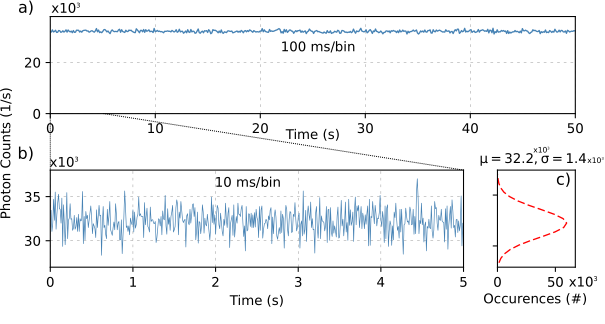
Figure 2.10: Photoluminescence stability. a) Recorded time trace of the photoluminescence of a single vsi with a bin width of 100 ms in a sample irradiated with 6×10¹³ cm⁻² b) Zoomed and binned with 10 ms. c) Histogram from b) fitted with a Gaussian with thousand photons per second, which equates to about 4% photon fluctuation.
As the photon flux is not much fluctuating in both short and long timescales, the created by electron irradiation fulfills the requirements. In (Fuchs et al., 2015) a large fluctuation at shorter time scale was reported for a supposedly vsi, which might be due to sample quality or due to irradiation with neutrons. As the neutron is a relative huge particle compared to electrons, neutron irradiation might cause more parasitic defects due to larger lattice damage.
Single Spin Detection
In the previous section it was shown that the emitters found in the 4H-SiC crystal are true single quantum emitters. However, based on the measurement in Figure 2.9 and the spectrum obtained at room temperature there is no proof that the observed emitter are true vsi or one of the many other defects (Maier, 1993). In order to proof that the quantum emitters originate from vsi there exist two approaches: one way is the observation of the zpl at low temperature, as the energy of radiative optical transition is characteristic for defects. Another possibility is to drive the electron spin and confirm the zero-field splitting of 70 MHz, which are reported for ensembles in literature (Janzén et al., 2009). Due to the lack of cryogenic temperatures, all experiments were conducted at room temperature and hence the single spin transition were measured and used as a proof of the existence vsi.
Spin Hamiltonian
The electronic ground state (GS) of the vsi can be well described by the following Hamiltonian:
where and are the longitudinal and transversal crystal field splitting parameters, the electron g-factor, the Bohr magneton and the projection of the spin to the symmetry axis of the defect. The spin operators for a spin system are given by:
For an arbitrary orientated -field the solution to the Hamiltonian in spherical coordinates is given by the secular equation (S. Y. Lee et al., 2015):
(2.3)
where and defines the polar angle.
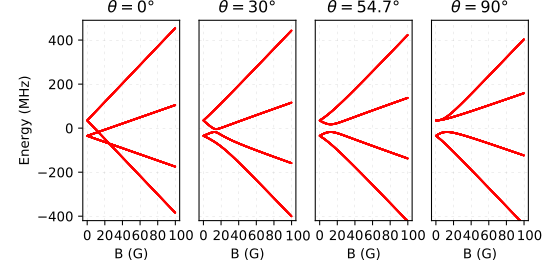
Figure 2.11: Ground state numerical eigenvalues. plotted as a function of the applied -field strength oriented along various angles inclined from the symmetry axis of the defect. Adapted from ref. (S. Y. Lee et al., 2015).
For crystals with zero strain, can be considered as an appropriate approximation, hence Equation 2.3 becomes to:
(2.4)
Due to the linear -term in Equation 2.4 the equation is solved numerically as plotted in Figure 2.11.
The linear term can be removed when becomes zero, which is the case for 54.7° and an analytical solution can be found easily (S. Y. Lee et al., 2015):
Because of that, this angle is called magic angle and can be used for a genuine vector magnetometer. Here, the fact is exploited that sharp transition lines occur only at this angle. For this purpose, the sensor is placed on a rotatable platform and rotated until the transitions are maximally sharp. This situation is well shown in ref. (S. Y. Lee et al., 2015).
For a magnetic field aligned to the symmetry axis of the defect, and without assuming , the solution of the Hamiltonian for , is given by:
The allowed spin transitions with are straightforwardly given by:
For the spin transitions can be simplified to:
(2.5)
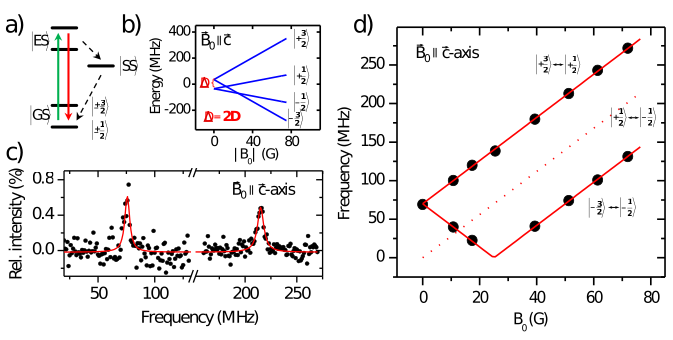
Figure 2.12: Optically detected magnetic resonance of a single . spin at room temperature. a) Energy level diagram for the vsi. The diagram shows ground state (GS), excited state (ES) and a metastable shelving state (SS). Non radiative transitions are shown as dashed lines are spin-dependent and are responsible for spin polarization into the GS. b) Simulated energy eigenvalues in frequency units, each spin level is calculated as a function of the external magnetic field in axial direction (along the symmetry axis of the defect). c) Room temperature cw-odmr measurement of a single vsi plotted as black dots. The relative fluorescence intensity is calculated as , where is the PL intensity at off-resonance. The data is fitted with Lorentzian fits (solid red lines) showing a full-width-half-maximum 6 MHz. d), Frequency dependence of experimentally measured odmr-lines plotted as a function of the external magnetic field . The red lines are calculated spin-transitions and , whereas the dashed line is the expected transition. Adapted from ref. (Widmann et al., 2015).
Experiment
Experimentally, a spin transition can be driven, if the rf field is resonant to a spin transition (see Section). This is usually achieved by either sweeping the magnetic field with having a fixed rf-frequency applied (as typically done in classical epr), or vice versa by a fixed magnetic field and sweeping the rf frequency. As the vsi has a characteristic zero-field splitting, an external magnetic field is in principle not mandatory to observe odmr. However, due to a weak residual magnetic field originating from magnetic parts in the setup, the lines are typically split into a complex structure at zero field (see Section 2.5.3).
In order to cancel the parasitic stray field ( ), a magnetic field much stronger than the stray field was aligned to the symmetry axis of the defect, as explained in . The odmr spectrum with an applied field = 50 G is shown in Figure 2.12. Here the transition at around 70 MHz is the transition whereas the transition appears at ~210 MHz, which will be explained in the following.
Once a transition-resonant frequency between and is applied, the spin is brought into a different state according to Fermi’s golden rule with the following probability:
In general, the transition rate depends on the coupling strength between the initial state and the final state , hence the coupling is maximized for . As SiC-crystals are grown along the -axis, samples are mostly mounted with the laser parallel to the -axis, an -shaped rf-loop often used for NV-centers in diamond is not suitable in this configuration.
It is known from previously performed ensemble measurements that the spin population among the magnetic sub-levels and are equal (Mizuochi et al., 2002). Because of that reason an applied rf-field resonant to does not change the populations and no transition is visible. In order to reveal transition, a depletion of one magnetic sub-level of to using pulsed rf-fields is necessary. In 2016, that was successfully demonstrated via odmr for an ensemble of vsi by Niethammer et al. in ref. (Niethammer et al., 2016).
Complex Fine Structure at Zero Field
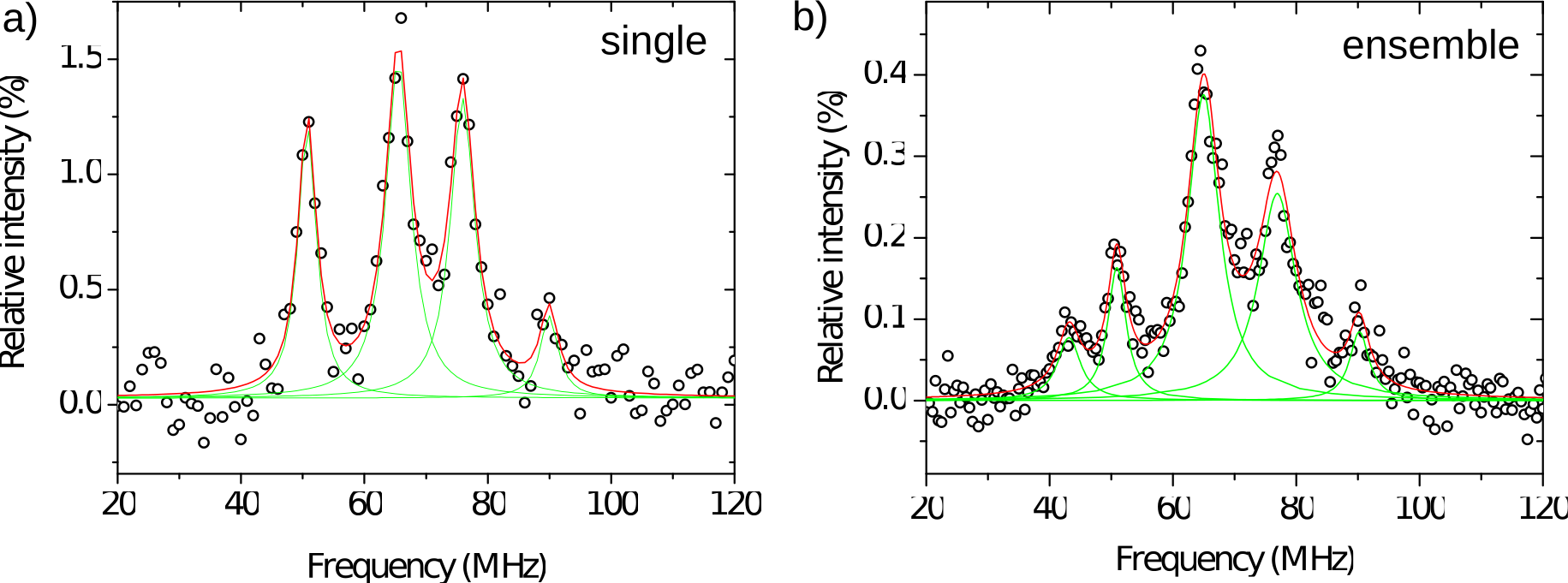
Figure 2.13: Complex fine structure at quasi zero field. Split by a parasitic magnetic field induced by magnetic parts in the objective (a) from a single vsi spin (b) from ensemble vsi spins. From ref. (Widmann et al., 2015).
When no magnetic field is applied only two overlapping spin transitions should be visible according to Equation 2.5, namely at 70 MHz the zfs. Figure 2.13 shows the “zero-field” odmr spectra of the single silicon vacancy from above discussion and an ensemble of vsi. Four sharp peaks are clearly seen in Figure 2.13a. The peaks are found at 51, 65, 76 and 90 MHz. A very similar structure was found in an ensemble sample ((1×10¹⁶ cm⁻²) e irradiation) sample plotted in Figure 2.13b. The peaks are located at 51, 54, 77 and 90 MHz. Such structure is not caused by hyperfine interaction with a nuclear spin located nearby the electron spin. In natural SiC two natural abundant non-zero nuclear spins are typically found, namely Si and C with abundances of 4.7% and 1.1%, respectively. The hyperfine coupling strength of C is larger than 30 MHz (Mizuochi et al., 2002). Obviously, the observed splittings of 11–13 MHz are much smaller than the hyperfine coupling strength of C. The remaining candidate, namely Si with nuclear spin cannot cause such splittings as well. Hyperfine coupling of Si isotope is found only when Si atoms are located at nnn positions. The probability of finding Si atoms at the nnn positions is 33%. Essentially, the hyperfine coupling strength is 8.7 MHz (Mizuochi et al., 2002), which is larger than the observed splittings. More experiments revealed the origin of the splitting. It is a residual magnetic field originating from the spring inside the oil-immersion objective. In ref. (Niethammer et al., 2016), the stray field was compensated using three-dimensional Helmholtz-coil pairs.
Conclusion and Outlook
This chapter showed the engineering of single vsi in 4H-SiC with 2 MeV electron irradiation. By varying the dose of the irradiation it was shown that it is possible to decrease the number of emitting defects to achieve samples with single silicon vacancies. The irradiation dose was varied over four orders of magnitude (between 1×10¹² cm⁻² and 1×10¹⁶ cm⁻²), which enables precise control of defect creation at various defect densities for various applications. Second order correlation measurement unambiguously proved the non-classical light originating from a true single quantum emitter. The photoluminescence intensity was estimated to be 14,000 photons per second. To increase the collection efficiency, a solid immersion lens was fabricated using focused ion beam milling. The collection efficiency was increased by a factor of 2.7. Finally, about 38,000 photons per second was extracted. The presented quantum emitter was clearly identified as the vsi by optically detected magnetic resonance techniques, which paves the way for coherent control of single defects at room temperature, as shown in Chapter 3.
In order to realize technological applications it is necessary to integrate single vsi into electronic and optical devices by positioning them at desired spatial locations with accuracies of about 10 nm–1 µm. By using conventional electron or neutron irradiation (Fuchs et al., 2015) homogeneously distribution of vacancies can be achieved but a spatial accuracy is not given. First attempts to achieve higher spatial accuracies were made in 2016, by proton irradiation, providing a better positioning accuracy in all three spatial dimensions (Kraus et al., 2017). In 2017, vsi creation was achieved via ion implantation (Wang et al., 2017), which can create shallow vsi, located about 40 nm below the surface. However, all these methods rely on bombardment with atoms, which not only create silicon vacancies but also may incorporate those into the crystal, or they induces damage to the surrounding crystal lattice. The former may result in un-intentional additional doping (Fuchs et al., 2015), the latter results in a potential shortening of the spin coherence time which makes the system less efficient of qip. A solution for this could be provided by the annealing of SiC at high temperatures. However the SiC lattice around silicon vacancy cannot be annealed, as the vsi vanishes at temperatures higher than 750°C (Itoh et al., 1990; Kawasuso et al., 1996; Maier, 1993) by converting to other more complex defects. Another, probably more efficient way for single vsi creation lies in the usage of strong pico-second lasting laser pulses, as shown for the NV-center in diamond (Chen et al., 2016a). Laser writing enables the direct creation of vsi into eg. the focal point of sils, by simultaneously monitoring the creation as the same experimental setup can be used for creation and detection.